It's summer, which means it's time for reading a little bit lighter fare than usual, correct? It was with this in mind that I picked up Mira Grant's zombie-thriller Feed a while ago. The book had everything I want in a summer read, it looked like a quick read, it had zombies, and it was well-reviewed. In fact, the book was nominated for the prestigious Hugo Award, given annually for the best science fiction/fantasy book. Feed looked trashy and interesting, so how could I say no?
Well, I'm glad I didn't. The book in set in 2039-40 and follows two bloggers, Shaun and Georgia Mason as they cover a presidential campaign. And there are zombies. The backstory here is that a hybrid virus (called Kellis-Amberlee) formed when two separate cures (for cancer and the common cold) combined in 2014. Now, the world has no more stuffy sinuses, and tobacco is big again (why not, without cancer?). However, when the two combined, they formed a virus that lives only to reproduce, and it reanimates the dead. By the time of the book, everyone has the virus in them, it's just that most people have it in the dormant state. Death or exposure to the live virus are enough to trigger an outbreak.
I don't want to go into too much detail here, because Grant (a pen-name for Seanan Maguire) did a lot of research in epidemiology to get this story right, and it's worth reading her take on the spread of Kellis-Amberlee. What I find really interesting here is the speculative view of the future, one in which bloggers provide most of the world's news. Georgia and Shaun get selected to tag along on a presidential campaign and begin to write for what will become one of the most important blogs of them all. Of course, no zombie novel would be complete without a lot of the walking dead, and we are treated to plenty in Feed.
But what really fascinates me about this book is the cognitive dissonance it caused me. On one hand, the writing here is often incredibly stilted. I can't even begin to tell you how many times we are told that Shaun likes to poke dead things with sticks. Or all about Georgia's (our narrator) virus-caused ocular disability (her eyes are always dilated). At times it's maddening, and there are passages that make me think of this tumblr.
And yet, I couldn't put it down. The story was able to overcome choppy writing, and it was riveting. There are times in which the book is just heartbreaking, and there are moments of great humor. Overall, it comes across as an interesting critique of the role of the press in society, all without being preachy. In short, it's a fun book that is able to push beyond its own flaws. Feed is the first book of the (cringe-inducing name approaching) Newsflesh trilogy. The second (Deadline... god, the puns) was released this May, and is now in my wish list. Feed isn't the best thing you'll read this summer, but it's good. And it has a weird way of sticking with you. That, mixed with the fact that it's a fast read make it the ideal book for these hot months.
Showing posts with label Review. Show all posts
06 June 2011
29 January 2011
Review: A King of Infinite Space
So I found this book on sale the other day for the Kindle. I also picked up Mercury Falls and Russell Wiley is Out to Lunch, but I doubt either of those will be quite as good. While the latter two are comedies or more light-hearted, A King of Infinite Space is a tense detective tale. It's a bit noir, but completely compelling and hard to put down.
Tyler Dilts writes the story of detective Danny Beckett and his partner Jen Tanaka. Beckett is a hardened homicide detective who is still struggling with the loss of his wife a couple of years earlier. They are part of a team investigating the brutal murder of a beloved young high school English teacher.
27 January 2011
Review: Mercury Falls
The world is ending. Or, at the very least, it's about to if Christine and her new-found friend Mercury can't stop it. Christine is a reporter for Christian newspaper, and Mercury is an avid enthusiast of ping-pong. Oh yeah, he's an angel as well.
Mercury Falls is the tale of Armageddon averted. It is nearly the time when the four attache cases (not horsemen) of the Apocalypse will be released and a great battle between the forces of God and Satan shall do battle. The only thing holding up the end of the world is a bit of bureaucracy. Robert Kroese paints a picture of an angelic world so caught up in red tape that they can't even figure out who is supposed to be the Antichrist. If you're a fan of dry humor and irreverence, you'll love this book.
21 January 2011
Review: Macklemore The VS EP (Not a book)
Usually you can expect to find book reviews here at Metro Marginalia, but I think I'm going to open things up a bit every now and again. And right now, I've got some music that I'm dying to talk about.
Macklemore, a rapper out of Seattle, first came to my attention with this post on my favorite baseball blog. It's his tribute to one of my favorite people ever, the voice of the Seattle Mariners, Dave Niehaus. The announcer passed away a few months ago, and to say it shocked me and others is an understatement. When I thought about it, Niehaus has to be one of the five or so voices I've heard most in my life, and he was really the voice of growing up for me. There was nothing better than turning on a Mariners game and getting to hear Dave spin a story.
Well, Macklemore and his producer Ryan Lewis got around to releasing the video for "My Oh My." And it's amazing. Take a look for yourself.
Macklemore, a rapper out of Seattle, first came to my attention with this post on my favorite baseball blog. It's his tribute to one of my favorite people ever, the voice of the Seattle Mariners, Dave Niehaus. The announcer passed away a few months ago, and to say it shocked me and others is an understatement. When I thought about it, Niehaus has to be one of the five or so voices I've heard most in my life, and he was really the voice of growing up for me. There was nothing better than turning on a Mariners game and getting to hear Dave spin a story.
Well, Macklemore and his producer Ryan Lewis got around to releasing the video for "My Oh My." And it's amazing. Take a look for yourself.
And if that was all Macklemore had ever done, I'd think of him pretty fondly. It's an amazing tribute to an amazing man. But, a cousin of mine was raving about the rapper over Christmas, so I decided to delve a bit more deeply. After all, it'd be pretty great to discover a good rapper from Seattle.
15 January 2011
Review: Sideways
So Sideways was one of the books I had on my Christmas list this year. I'd seen the movie and wanted to find out if the book compared well. And honestly, I can't remember the last time I was so conflicted by a book. Rex Pickett's writing is terrible, but the story was awfully compelling. I gave it three stars on Goodreads, but I could have easily gone up or down one star depending on what I was really rating.
12 January 2011
Welcome Back My Friends!
Well, I've been being hassled by V for a bit to start this whole shindig up again. I haven't neglected the site because I haven't been reading, but rather because I've been writing elsewhere, and it's taken up a ton of my time. But then V pointed out last night that it really hasn't taken up too much time. "You know, it doesn't take that long to write a blog post." And she's right.
So here I am again, after nearly 8 months. And let's just dive right in with a book review, shall we? Recently, I read about the upcoming HBO series A Game Of Thrones. That piqued my interest, but not for the show. Instead, I wanted to read the book. Before I get to anything else, let me say "thank heavens for the Kindle."
Labels:
A Game of Thrones,
Fiction,
George R. R. Martin,
Review
25 May 2010
Review: Death in Venice
Well if a book has ever left me with a deep ennui, this was it. I started off hating it, and by the end, I just didn't even care a little. I read it because I plan on studying Benjamin Britten, and he wrote an opera based on the story. Death In Venice is one of German writer Thomas Mann's most famous works, and it's so universally praised that I feel a bit weird for disliking it.
But I just can't get over how unrelentingly creepy it is. Aschenbach, the main character, is a famed, middle-aged, German writer in the pre-WWI 1910s. He feels a deep malaise for his work and decides to go on a trip. He ends up in Venice as Cholera begins to spread in the city. There, he falls madly in love with a 14-year old boy, Tadzio.
Now, Tadzio is apparently beautiful. But that's what you would expect of a thinly veiled metaphor for Apollo. Of course the sun/light/truth god is beautiful, this isn't Hephaestus. So we get to see Tadzi-apoll-o running about the shore and making Aschenbach's day. Sure, Aschenbach never does anything, but he lusts over the boy like a dog looking at a T-Bone. (Also, allow me to clarify that the age is what I have a problem with here, not the fact that both are male).
Thankfully, we're spared Aschenbach's continued awkward creepiness by his untimely death (spoiler alert). It was incredibly abrupt and felt like it came out of nowhere. I'd've been upset if it hadn't felt so merciful.
That said, I did manage to get one awesome line out of the book (one that I think I will use for conference papers when I turn my thesis into them):
But I just can't get over how unrelentingly creepy it is. Aschenbach, the main character, is a famed, middle-aged, German writer in the pre-WWI 1910s. He feels a deep malaise for his work and decides to go on a trip. He ends up in Venice as Cholera begins to spread in the city. There, he falls madly in love with a 14-year old boy, Tadzio.
Now, Tadzio is apparently beautiful. But that's what you would expect of a thinly veiled metaphor for Apollo. Of course the sun/light/truth god is beautiful, this isn't Hephaestus. So we get to see Tadzi-apoll-o running about the shore and making Aschenbach's day. Sure, Aschenbach never does anything, but he lusts over the boy like a dog looking at a T-Bone. (Also, allow me to clarify that the age is what I have a problem with here, not the fact that both are male).
Thankfully, we're spared Aschenbach's continued awkward creepiness by his untimely death (spoiler alert). It was incredibly abrupt and felt like it came out of nowhere. I'd've been upset if it hadn't felt so merciful.
That said, I did manage to get one awesome line out of the book (one that I think I will use for conference papers when I turn my thesis into them):
But in empty, unarticulated space our mind loses its sense of time as well, and we enter the twilight of the immeasurable.
20 May 2010
Review: The Unnamed
Joshua Ferris completely hooked me with his first book, Then We Came to the End. It was an almost Heller-esque portrayal of office-life. Well, if you know me, "Heller-esque" is about the best characteristic I can think of in a book: the portrayal of both the banal and phenomenal in an absurd light makes for great reading.
So I eagerly anticipated his second offering. Released in January of this year, and titled The Unnamed, V and I picked up a copy at Borders a little later. I've just finally gotten around to reading it, and it was worth the wait. (She did read it before I did, and you can find her review here). It is the tale of Tim Farnsworth, a man with an unnamed disease. You see, Tim goes for walks. But not like those that you or I take, rather these are walks that come upon him suddenly and which he cannot control. His body forces him to walk and the only thing it does otherwise is avoid danger (somehow). After countless doctors and innumerable attempts to figure out what is wrong (is it psychological or physiological?), Tim and his wife have pretty much given up hope of ever ending it.
But the "disease" does go into remission, and during those periods, they're able to live a peaceful life with their daughter. Tim is a partner at a powerful law firm in New York City, and he's got a client that he needs to get off the hook for murder. As the case is readying to begin though, the disease comes back.
Now it doesn't seem like walking would be such a problem. We all do it, after all. But Tim walks to the point of exhaustion, and then falls asleep wherever his body needs to. He doesn't always know where he is, and her certainly can't control when it begins. So he has to keep a backpack with necessities in it with him at all times. And in the winter, he needs appropriate clothes.
The story is really well written, and the best parts are those in which we see the cracks in the relationship between Tim and his wife. There's an obvious and deep love, but the strain the disease puts on both of them is extreme. The thing I've noticed about Ferris is that I don't always love his plots, but he excels at writing about interpersonal relationships so well that I can overlook that. The books are character studies, and the plots are merely instruments to manipulate and expose that character.
It's definitely worth a read, and you'll be thinking about it for days. And if you haven't read Ferris's first book, grab that one too. It's probably the better of the two, but that doesn't mean you should skip The Unnamed, even if you have to walk to the bookstore to get it.
So I eagerly anticipated his second offering. Released in January of this year, and titled The Unnamed, V and I picked up a copy at Borders a little later. I've just finally gotten around to reading it, and it was worth the wait. (She did read it before I did, and you can find her review here). It is the tale of Tim Farnsworth, a man with an unnamed disease. You see, Tim goes for walks. But not like those that you or I take, rather these are walks that come upon him suddenly and which he cannot control. His body forces him to walk and the only thing it does otherwise is avoid danger (somehow). After countless doctors and innumerable attempts to figure out what is wrong (is it psychological or physiological?), Tim and his wife have pretty much given up hope of ever ending it.
But the "disease" does go into remission, and during those periods, they're able to live a peaceful life with their daughter. Tim is a partner at a powerful law firm in New York City, and he's got a client that he needs to get off the hook for murder. As the case is readying to begin though, the disease comes back.
Now it doesn't seem like walking would be such a problem. We all do it, after all. But Tim walks to the point of exhaustion, and then falls asleep wherever his body needs to. He doesn't always know where he is, and her certainly can't control when it begins. So he has to keep a backpack with necessities in it with him at all times. And in the winter, he needs appropriate clothes.
The story is really well written, and the best parts are those in which we see the cracks in the relationship between Tim and his wife. There's an obvious and deep love, but the strain the disease puts on both of them is extreme. The thing I've noticed about Ferris is that I don't always love his plots, but he excels at writing about interpersonal relationships so well that I can overlook that. The books are character studies, and the plots are merely instruments to manipulate and expose that character.
It's definitely worth a read, and you'll be thinking about it for days. And if you haven't read Ferris's first book, grab that one too. It's probably the better of the two, but that doesn't mean you should skip The Unnamed, even if you have to walk to the bookstore to get it.
11 May 2010
Review: Are We Winning?
Anyone who has read what I write here knows that I love baseball. It is, without question, the greatest sport ever put on this planet, and one of my absolute favorite ways to spend a few hours. So despite the fact that I was not smitten with his last work (God Save The Fan, essentially a collection of long-winded Deadspin essays), I couldn't wait to get my hands on Will Leitch's new book, Are We Winning? Fathers and Sons in the New Golden Age of Baseball.
Leitch is at his best when he writes about baseball. He's got a way with words that incorporates the modern view of the game with the romanticized purple prose of bygone years. It's easy to understand why: he grew up idolizing newspaper legends and went to the University of Illinois with the explicit purpose of becoming one of them. His two passions have been movies and sports, and it is in the field of sports that he truly shines.
Leitch grew up as a Cardinals fan, and he's been able to avoid any wavering from that, thanks in large part to his father. The elder Leitch gave his son sage advice when he left for college: "There's going to be a lot of Chicago people up there, and a lot of Cubs fans. You can fool around with a Cubs fan if you want, but don't you dare bring one home." Are We Winning? is primarily a book about the relationship of Will and Bryan Leitch, and how that has been built around baseball. Bryan Leitch seems like an amazing guy, but he also seems like the stock character father from the Midwest: stoic, hard-working, hard-drinking, and with charisma that bubbles over, allowing him to make friends with anyone anywhere (as with a man at Wrigley wearing a Cubs shirt and a Cardinals hat [makes me sick to my stomach to hear about that]).
The best parts of the book are unquestionably those that deal with the father-son dynamic. Leitch manages to make his stock-character father seem like something more than that. He could have easily left his father with the stereotypical traits and had a fine story, but instead he delves even further and allows the reader to see past the clip-art version of a Midwesterner.
Other parts of the book seem to lag just a little, but probably only because of their juxtaposition with the father-son bits. Are We Winning? is organized into the half-innings of a game that Leitch and his dad attended at Wrigley in 2008. The two die-hard Cardinals fans unwittingly ended up at the game where the Cubs are given the chance to clinch the NL Central against the Cardinals, while Tony LaRussa's squad floundered just out of reach of playoff contention. In each half-inning Leitch weaves general baseball stories with play-by-play of the game and the bits of the father-son relationship.
The general thesis of the baseball stories seems to be, as implied in the subtitle, that baseball is better now than it has ever been. This flies in the face of many baseball old-timers, who see the sport as constantly leaving its better days behind. But Leitch is able to offer a convincing argument: more people watch baseball now than have ever done so before, they are able to access more and better information than before, and the players are better than they ever have been. He's right on all three counts. The athleticism of even the worst baseball players (read: Yuniesky Betancourt) is better today than ever before, and it's led to better baseball. And with MLB.tv and other advances from MLB Advanced Media as well as innumerable blogs and other websites dedicated to baseball, we're more able to access information about this better game. I'm able to follow the Seattle Mariners while living in Washington, DC, and I'm actually able to do so better than I did when I lived in Washington state 6 years ago. That is incredible.
But what happens in the book is that these baseball stories get overshadowed by how incredibly good Leitch's writing about his father is. I love reading random bits about baseball, especially when they're written by Will Leitch. But here, I wanted to read even more about his dad. Maybe this is just the desire for a deeper connection with a parent over baseball. My dad never cared about baseball too much (always supported my little league playing, and went to Mariners games with me, but hates them for being "crybaby millionaires"), and though my mom coached my little league team and always let me watch the Mariners, she hardly follows them any more (she told me the other day "I really only know two guys on this year's team: Griffey and Ichiro." She didn't know Felix Henandez, one of the top-3 pitchers in the American League. See what I mean?). I'd love to have a baseball connection with a parent like Leitch does, and I think that's what made his stories so compelling, and what made the purely baseball anecdotes so anticlimactic.
That said, I can't recommend this book enough. It has some flaws (Leitch periodically reintroduces anecdotes throughout the book that he has already used before several times, and always treats them as new. This really annoyed me for some reason.), but they don't end up doing any major damage to the book. It's a quick read, and one that I'll probably come back to at some point. Why? Because even with its problems, baseball is still the best thing around. Like Leitch says, "We expect baseball to be perfect, all the time. And it is perfect. But it is run by human beings, who are far from perfect, who are not even close." No matter what those human beings do, they can't change the fact that baseball is perfect. Thanks, Will, for reminding why I love this game so damn much.
Leitch is at his best when he writes about baseball. He's got a way with words that incorporates the modern view of the game with the romanticized purple prose of bygone years. It's easy to understand why: he grew up idolizing newspaper legends and went to the University of Illinois with the explicit purpose of becoming one of them. His two passions have been movies and sports, and it is in the field of sports that he truly shines.
Leitch grew up as a Cardinals fan, and he's been able to avoid any wavering from that, thanks in large part to his father. The elder Leitch gave his son sage advice when he left for college: "There's going to be a lot of Chicago people up there, and a lot of Cubs fans. You can fool around with a Cubs fan if you want, but don't you dare bring one home." Are We Winning? is primarily a book about the relationship of Will and Bryan Leitch, and how that has been built around baseball. Bryan Leitch seems like an amazing guy, but he also seems like the stock character father from the Midwest: stoic, hard-working, hard-drinking, and with charisma that bubbles over, allowing him to make friends with anyone anywhere (as with a man at Wrigley wearing a Cubs shirt and a Cardinals hat [makes me sick to my stomach to hear about that]).
The best parts of the book are unquestionably those that deal with the father-son dynamic. Leitch manages to make his stock-character father seem like something more than that. He could have easily left his father with the stereotypical traits and had a fine story, but instead he delves even further and allows the reader to see past the clip-art version of a Midwesterner.
Other parts of the book seem to lag just a little, but probably only because of their juxtaposition with the father-son bits. Are We Winning? is organized into the half-innings of a game that Leitch and his dad attended at Wrigley in 2008. The two die-hard Cardinals fans unwittingly ended up at the game where the Cubs are given the chance to clinch the NL Central against the Cardinals, while Tony LaRussa's squad floundered just out of reach of playoff contention. In each half-inning Leitch weaves general baseball stories with play-by-play of the game and the bits of the father-son relationship.
The general thesis of the baseball stories seems to be, as implied in the subtitle, that baseball is better now than it has ever been. This flies in the face of many baseball old-timers, who see the sport as constantly leaving its better days behind. But Leitch is able to offer a convincing argument: more people watch baseball now than have ever done so before, they are able to access more and better information than before, and the players are better than they ever have been. He's right on all three counts. The athleticism of even the worst baseball players (read: Yuniesky Betancourt) is better today than ever before, and it's led to better baseball. And with MLB.tv and other advances from MLB Advanced Media as well as innumerable blogs and other websites dedicated to baseball, we're more able to access information about this better game. I'm able to follow the Seattle Mariners while living in Washington, DC, and I'm actually able to do so better than I did when I lived in Washington state 6 years ago. That is incredible.
But what happens in the book is that these baseball stories get overshadowed by how incredibly good Leitch's writing about his father is. I love reading random bits about baseball, especially when they're written by Will Leitch. But here, I wanted to read even more about his dad. Maybe this is just the desire for a deeper connection with a parent over baseball. My dad never cared about baseball too much (always supported my little league playing, and went to Mariners games with me, but hates them for being "crybaby millionaires"), and though my mom coached my little league team and always let me watch the Mariners, she hardly follows them any more (she told me the other day "I really only know two guys on this year's team: Griffey and Ichiro." She didn't know Felix Henandez, one of the top-3 pitchers in the American League. See what I mean?). I'd love to have a baseball connection with a parent like Leitch does, and I think that's what made his stories so compelling, and what made the purely baseball anecdotes so anticlimactic.
That said, I can't recommend this book enough. It has some flaws (Leitch periodically reintroduces anecdotes throughout the book that he has already used before several times, and always treats them as new. This really annoyed me for some reason.), but they don't end up doing any major damage to the book. It's a quick read, and one that I'll probably come back to at some point. Why? Because even with its problems, baseball is still the best thing around. Like Leitch says, "We expect baseball to be perfect, all the time. And it is perfect. But it is run by human beings, who are far from perfect, who are not even close." No matter what those human beings do, they can't change the fact that baseball is perfect. Thanks, Will, for reminding why I love this game so damn much.
04 May 2010
Review: I, Lucifer
We've got a long tradition of stories involving the devil from a slightly more humanized view than what the bible gives us. Certainly, many of them still paint him to be evil, but they create a true character. Faust comes to mind, as does the Rolling Stones' "Sympathy for the Devil." Blues musician Robert Johnson was thought to have sold his soul at the crossroads for his ability to play guitar, and who can forget Johnny betting that he can play the fiddle better than Satan? (And of course, Tenacious D met some sort of devil, but banished him with the Greatest Song in the World)
All the music references are the slow way of getting to the topic of today, Glen Duncan's I, Lucifer: Finally, the Other Side of the Story. The book was recommended to me by Jessica Abbazio, a fellow grad student who was working on a paper about the personification of the devil in the Stones' song. Her paper was fascinating, as was the book she sent my way.
The basic premise here: God is giving Lucifer another chance. Lucifer, who only exists in a spiritual realm (and can't even see what we see, but rather the impacts of his doings on our souls), doesn't buy it, but the setup is too good to pass on. He is to inhabit the body of a failing writer, Declan Gunn (took me half the book to figure out it was an anagram for the author), who was about to commit suicide when God snatched his soul away. The upside for Lucifer is that he gets a one-month trial run in the city of London. If he wants to give it a go, he stays in the body and tries to live a good life. If not, he can return to being Lucifer.
What follows is a month of debauchery, where the devil wrecks Gunn's body. He takes drugs, drinks, has promiscuous sex (with the ladies of the XXX-quisite escort service), cheats on Gunn's girlfriend, cheats on his mistresses. He's, pretty much, a little devil. The problem for Lucifer is that he starts to reconsider: should he stay in the body and take his one shot at eternal redemption?
The conceit behind the book is great, and Gunn (whoops, Duncan) pulls it off marvelously. I can't say too much, as the reader is left constantly wondering which way Lucifer chooses. But it's certainly worth a read, and it's definitely quick. If you hadn't had the chance, pick up a copy. I'm sure it can be had for less than a soul.
All the music references are the slow way of getting to the topic of today, Glen Duncan's I, Lucifer: Finally, the Other Side of the Story. The book was recommended to me by Jessica Abbazio, a fellow grad student who was working on a paper about the personification of the devil in the Stones' song. Her paper was fascinating, as was the book she sent my way.
The basic premise here: God is giving Lucifer another chance. Lucifer, who only exists in a spiritual realm (and can't even see what we see, but rather the impacts of his doings on our souls), doesn't buy it, but the setup is too good to pass on. He is to inhabit the body of a failing writer, Declan Gunn (took me half the book to figure out it was an anagram for the author), who was about to commit suicide when God snatched his soul away. The upside for Lucifer is that he gets a one-month trial run in the city of London. If he wants to give it a go, he stays in the body and tries to live a good life. If not, he can return to being Lucifer.
What follows is a month of debauchery, where the devil wrecks Gunn's body. He takes drugs, drinks, has promiscuous sex (with the ladies of the XXX-quisite escort service), cheats on Gunn's girlfriend, cheats on his mistresses. He's, pretty much, a little devil. The problem for Lucifer is that he starts to reconsider: should he stay in the body and take his one shot at eternal redemption?
The conceit behind the book is great, and Gunn (whoops, Duncan) pulls it off marvelously. I can't say too much, as the reader is left constantly wondering which way Lucifer chooses. But it's certainly worth a read, and it's definitely quick. If you hadn't had the chance, pick up a copy. I'm sure it can be had for less than a soul.
28 April 2010
Review: The Guns of August
My Aunt May has been telling me to read Barbara Tuchman's The Guns of August for what seems to be ages. Boy was I stupid not to do so as soon as she recommended it. Tuchman's work recounts the first month of World War I: August, 1914. I have to admit to knowing very little about WWI, but this made for a great primer into the causes of the war as well as the reasons it got bogged down in the trenches.
A few things surprised me about the opening month of the war. The first was the transitional state that war was in. We tend to think of war as something that happened before mechanized weaponry or something that happened after. WWI shows that this was not the case. Weaponry used in battle of course included heavy artillery, rifles, airplanes, and machine guns. But it also included lances, bicycles, horses, and bayonets. Some of the massive casualties were undoubtedly caused by these discrepancies in firepower. I had the hardest time wrapping my mind around the idea of war that wasn't quite 19th Century but also wasn't firmly 20th Century either.
But the highlight of this book is Tuchman's writing. It took me a while to read, but a lot of that was owed to thesis writing. Tuchman's prose is absolutely gorgeous, and it draws you in. Throughout the book, I found myself angry and sympathizing with the Germans, British, French, Russians, and Belgians. She didn't allow retrospective history to get in the way of writing: the Germans aren't evil, and the British aren't demi-gods. All of the participants are instead just fallible human beings. Its devastating to realize how much human life was lost in the stupidity, and Tuchman really details the magnitude of tragedy involved, regardless of side.
While a lot of people who read the book focus on the (admittedly wonderful) first paragraph, I had a different favorite that really shows Tuchman's style. In Chapter 22, as she is setting up the Battle of the Marne that was to decide the fate of France, Tuchman writes this:
What a beautiful way to set the stage for one of history's most important days.
If you haven't read The Guns of August and you have even a modicum of interest in history, pick up a copy. It is easily one of the best history books I've ever come across.
A few things surprised me about the opening month of the war. The first was the transitional state that war was in. We tend to think of war as something that happened before mechanized weaponry or something that happened after. WWI shows that this was not the case. Weaponry used in battle of course included heavy artillery, rifles, airplanes, and machine guns. But it also included lances, bicycles, horses, and bayonets. Some of the massive casualties were undoubtedly caused by these discrepancies in firepower. I had the hardest time wrapping my mind around the idea of war that wasn't quite 19th Century but also wasn't firmly 20th Century either.
But the highlight of this book is Tuchman's writing. It took me a while to read, but a lot of that was owed to thesis writing. Tuchman's prose is absolutely gorgeous, and it draws you in. Throughout the book, I found myself angry and sympathizing with the Germans, British, French, Russians, and Belgians. She didn't allow retrospective history to get in the way of writing: the Germans aren't evil, and the British aren't demi-gods. All of the participants are instead just fallible human beings. Its devastating to realize how much human life was lost in the stupidity, and Tuchman really details the magnitude of tragedy involved, regardless of side.
While a lot of people who read the book focus on the (admittedly wonderful) first paragraph, I had a different favorite that really shows Tuchman's style. In Chapter 22, as she is setting up the Battle of the Marne that was to decide the fate of France, Tuchman writes this:
September 4 opened with a sense of climax felt in widely separated places; a kind of extra-sensory awareness that great events sometimes send ahead. In Paris, Gallieni felt this was the "decisive" day. In Berlin, Princess Blücher wrote in her diary, "Nothing is talked of but the expected entry into Paris." In Brussels the leaves had begun to fall, and a sudden wind blew them in gusts about the street. People felt the hidden chill of autumn in the air and wondered what would happen if the war were to last through the winter. At the American Legation Hugh Gibson noted a "growing nervousness" at German Headquarters where there had been no announcements of victories in four days. "I am sure there is something big in the air today."
What a beautiful way to set the stage for one of history's most important days.
If you haven't read The Guns of August and you have even a modicum of interest in history, pick up a copy. It is easily one of the best history books I've ever come across.
02 March 2010
Review: Odd Man Out
Aside from music, one of my biggest passions in life is baseball. Since 1994 I've been a huge fan of the Seattle Mariners. I care far too much about baseball and spend far too much time reading about it online. But one thing I don't read enough of is baseball books. When I read The Boys of Summer by George Kahn, I loved it (or at least the first half of it). I've read some other baseball stuff that is just superb. But then you get the real clunkers. And when a baseball book stinks, it's just unbearable. I want them to be good so badly that it upsets me when they are not.
Well I was killing some time at the UMD bookstore the other day, and came across Odd Man Out: A Year on the Mound with a Minor League Misfit by Matt McCarthy. I'm not sure why it struck me, but I looked it up on my Kindle and downloaded it there. I've never been happier with a baseball book in my life. It doesn't have any of the sabermetric statistics that I'm learning to like, and it isn't really advanced technically. What it is is a superb recounting of McCarthy's year in the Anaheim Angel's farm system.
McCarthy was a left-handed pitcher for an abysmal Yale team. In 2002, after graduating from one of the top universities in the world, he was picked in the 21st round of the amateur draft by the Angels. 21st-round picks are usually people that will never make an impact on the big-league team. And the same is true of McCarthy. But his assignment to the Provo Angels, based in the geographic heart of the Mormon religion provides for some fantastic stories, and we're lucky they were experienced by someone who can write as well as McCarthy does.
He tells of extended spring training and his time in Provo, UT. But the best part of the book is the detailing of the players themselves. We get some big names (new Mariners 1B Casey Kotchman's dad is McCarthy's manager in Provo. White Sox closer Bobby Jenks makes a cameo as a drunk blowhard [which in turn makes me like Jenks even more now that I see his complete transformation], Joe Saunders is hated by his teammates, Ervin Sanatana puts no effort into his game, and Alberto Callaspo engages in hijinks galore), and we get some people that even the most avid baseball fan hasn't heard of.
These are the people that make the story special. Two players come immediately to mind, and both were (at one point) McCarthy's roommates. The first roommate, always referred to as Sunshine, was a bit of an eccentric player, who most of the team thought was only there as a favor. He served the season as the bullpen catcher, one of the least glorious jobs in all of baseball. After initially disliking him, McCarthy seems to end up with a great fondness for the crazy Californian.
The other is Randy Burden, a devout Christian who tried to push the Bible onto McCarthy while also trying to be supportive in a non-imposing way. McCarthy details the brusque manner in which he treated Burden, and then reveals that Burden died after the 2002 season. You can sense a profound regret in McCarthy's writing both that he wasn't there for his teammate in life, and afterwards. These segments must have been very difficult for McCarthy to write, as he lays himself out as kind of an ass.
The other truly inspiring character is Tom Kotchman, the Provo Angel's manager. The way he is described, he is truly a "player's manager."If his team plays baseball the "way it was meant to be played" he'll do anything for them. At one point, Kotchman offers any money that his players need with no strings attached. For some, this was they only way they could eat on the meager rookie-ball salary they received. As clichéd as it sounds, I absolutely loved this bit from Kotchman:
If you play hard for me, I will do anything for you. Anything! And to see some of you just going through the motions... it kills me. You're disrespecting the game!These kids were given the chance to live the dream of thousands of people. To play professional baseball. And while you can't blame them for taking it for granted (most people who routinely do amazing things take them for granted), you have to appreciate what Kotchman is trying to instill in his players.
The author is very straightforward about the fact that he wasn't a very good pitcher. Without fear of spoiling anything (it pretty much gives the ending on the back cover), I note that even though McCarthy got cut in Spring Training of 2003, he's not doing too shabbily for himself: having attended Harvard Medical School.
If you're looking for a good baseball book, but this one now. The pace was fast and the story telling was phenomenal. I can't recommend it enough.
26 February 2010
Review: Up In The Air
A couple of weekends ago, I had a free Saturday. I had no idea what to do, so I started trying to see if I could find any movies that I would want to but Victoria wouldn't. I saw that Up In The Air was playing at the Gallery Place theatre. Now, I will see pretty much anything with George Clooney in it, and I had heard enough good reviews to make seeing this in the theatre worth it. Turns out, I freaking loved the movie. Some nice humor, nothing too over-the-top, a bit of dark human drama. Pretty much everything I could ask for in a movie.
I decided to pick up Walter Kirn's novel of the same name on which the movie was based. I of course expected some changes, but the general plot would be the same, right? Absolutely not. The book and the movie share a few things:
- Ryan Bingham is the protagonist and narrator
- Alex is a love interest
- Ryan's sister is getting married
- Ryan is attempting to reach a high number of frequent flier miles (the actual # is different)
- Ryan fires people for a living
Now that seems like a pretty substantial list. But there are some major differences. The book's Bingham looks forward to not flying. The movie's would find this insufferable. The book's Bingham is based out of Denver and spends most of his time in the West, while hoping for a job in Omaha. The movie's is based in Omaha and is trying to keep his job there while flying across the entire nation.
But the biggest difference between the two is who Ryan Bingham really is. In the movie, I saw Bingham as a fairly down-to-earth (despite all the flying) guy with some definite family and social issues, but nothing you wouldn't expect from a guy who spends his life in the air (to the tune of 10 million miles, all domestic). In the book, we are led to believe that Bingham is either insane, or just very amnesiac. (It's worth noting that other people have seen the insanity in the movie's Bingham. In his review of the movie, Will Leitch writes "Isn’t Ryan Bingham, all told, kind of insane? Just a step or two removed from Adam Sandler’s Barry Egan in Punch Drunk Love, he’s obsessed with American Airline frequent flier miles, a loner misfit who can’t interact with another human being longer than it takes to pay a bar tab." So there is that.)
Also, the book's Bingham has a strange fascination with drugs that leads to an episode in Las Vegas which was one of the most disenchanting passages I've read in a while. It is completely out of the realm of possibility to think that the movie version of Bingham would have this same thing happen. And here's where I am a bit confused. Did I find this passage so horrible because I was upset that our "hero" becomes an antihero? I'd like to think I've got enough appreciation for dark literature/film/etc. to like a good antihero, but here I'm not sure. I was really pulling for Bingham to have some sort of fulfillment, and he doesn't get it. Part of my problem though is that the Las Vegas scene doesn't seem entirely believable. Maybe it's partially the movie image of Bingham I had, but I never was able to fully believe that even book Bingham would go on a Vegas bender. It seems too cliché.
All of this said, would I recommend it? Sure. It's a really fast read, and it does have some interesting bits. For instance, this take on materialism (note: Great West is the made-up airline Bingham flies):
I know of no pleasure more reliable than consuming a great American brand against the backdrop featured in its advertising. Driving a Ford pickup down brown dirt roads. Swigging a Coke on the beach in Malibu. Flying Great West over central Colorado. It's a feeling of restfulness and order akin, I suspect, to how the ancient Egyptians felt watching the planets line up above the Pyramids. You're in the right place, you're running with the right forces, and if the wind should howl tomorrow, let it.
So yeah, if you've got nothing better to read, pick up a copy of Up In the Air, but I don't think it's anything you should specifically make time for.
22 February 2010
Review: Right Ho, Jeeves
I had read somewhere about the P.G. Wodehouse "Jeeves & Wooster" stories. I'm not sure where, and I don't quite remember when, but for some reason it piqued my interest. They were described as riotously funny British humor, and that tends to be something up my alley. After some searching, I found out it didn't matter what order one read the stories in, as none of the plots relied on one another. So I dove into one I found for free on Project Gutenberg: Right Ho, Jeeves. Let me go ahead and ruin any anticipation by saying: go buy this now.
That's Stephen Fry as the butler (actually, valet, but we'll go with butler) Jeeves, and Hugh Laurie as Bertram Wooster. Jeeves is your (stereo)typical tight-lipped butler, always willing to do what is asked of him despite what may be obvious defects in a plan. Bertram Wooster is a well-meaning dunderhead, as well as our narrator. Everything he touches gets all mussed up, and it falls to Jeeves to fix it. In Right Ho, Jeeves alone Wooster messes up (and Jeeves fixes)
- The engagement of his cousin
- The love affairs of a school-friend
- The state of employ of the French chef Anatole at his aunt's estate
- The viability of his Aunt's newspaper
- A speech giving awards at a local grammar school
The typical formula is as follows: Jeeves wants to fix something, Wooster thinks he can do better, Wooster fails, Wooster fails some more, Wooster proves that there is no floor to failure, Jeeves fixes it all somehow. This seems like it could get tedious, but Wodehouse writes with such concise wit that it never does.
Another part of why this book was so delightful is that it's an early-30s period piece. What a fantastic time to set a story in. Neat cars, lots of fine drinks, trains to Cannes for the summer, and the leftover sexual inhibitions of the Victorian era coexisting with a more liberal ideology.
I think it's best just to have a few quotes here. They're taken entirely out of context, but you don't really need the context to get the wit (though it does make it even better).
And yet, if he wants this female to be his wife, he's got to say so, what? I mean, only civil to mention it.
I studied it in a profound reverie for the best part of two dry Martinis and a dividend.
I could not but remember how often, when in her company at Cannes, I had gazed dumbly at her, wishing that some kindly motorist in a racing car would ease the situation by coming along and ramming her amidships. As I have already made abundantly clear, this girl was not one of my most congenial buddies.
Uncle Tom, in addition to not liking burglars, is a bloke who has always objected to the idea of being cooked in his sleep, so when he bought the place he saw to it that the fire bell should be something that might give you heart failure.
And finally, on Jeeves:
To the best of my knowledge, he has never encountered a charging rhinoceros, but should this contingency occur, I have no doubt that the animal, meeting his eye, would check itself in mid-stride, roll over and lie purring with its legs in the air.
The whole thing is delightful, like reading a period version of The Hitchhiker's Guide or the novel on which half of Monty Python was based. If you've got any taste for British humor, it's an absolute must-read.
11 February 2010
Review: The Iliad
I finally finished The Iliad yesterday after having it slowed a bit by reading Pride and Prejudice. It was a phenomenal book, but tended to get a bit repetitive in parts. But there is even a reason for that, and it's one I can understand. What the story does really well is portray some characters very deeply, and make them really connect with the reader. I'll break this review down into the good and the bad.
First, the bad: the battle scenes tended to blend in my mind. Though the battles themselves are described in incredible detail, the acts of heroism become redundant after a while. I get that big Ajax is really quite strong. As is Hector. As is Agamemnon. As is Patroclus. As is... you get the point. There are only so many times I want to read something along the lines of "He challenged the son of _____ and called on (insert God here) to help him. He let fly his spear and it hit the buckler in the middle and pierced through. The dark death fell over _______'s eyes." Unless I am invested in the person, why do I need to know their background?
Now, there's a reason for this. The Iliad is a sort of history, but it was also originally sung or recited. The repetitiveness makes two things possible: comprehensiveness and flow. So that's why, while it bugged me, the nitty gritty wasn't a dealbreaker with this story. Which leads me to...
The good: the breadth, emotion, horror, and beauty of this story are unbelievable. Those characters that do play major roles are well-developed. You can't help but feel terribly as Achilles weeps over the death of his friend Patroclus. And the same goes for Priam as he tries to regain the body of Hector. The Iliad really doesn't hide the emotion and pain of war at all, be it through graphic descriptions of killing or heart-rending passages about those affected by the war. There is a reason this story has survived for thousands of years: it's incredibly compelling. Sure, in our modern time some of it seems unbelievable, but I think that added to it. Two armies fighting seems stupid. Two armies fighting while a group of gods do the same on the same field? That seems epic, and as if it is somehow more important. Does it make sense that way? Not really. Nevertheless, that's what I ended up feeling when I read this.
If, like me, you've waited this long to read The Iliad, don't hesitate any more. Go out and get Robert Fagles' translation (it was amazingly good, and never got bogged down in weird turns of phrase) and read it soon. At some point in the near future, I'll be diving into his version of The Odyssey, so expect a report from that in the next couple of months. I need a break from epics for a bit though. So next up will be P.G. Wodehouse's Right Ho, Jeeves, which I'm already halfway through. Look for that soon!
First, the bad: the battle scenes tended to blend in my mind. Though the battles themselves are described in incredible detail, the acts of heroism become redundant after a while. I get that big Ajax is really quite strong. As is Hector. As is Agamemnon. As is Patroclus. As is... you get the point. There are only so many times I want to read something along the lines of "He challenged the son of _____ and called on (insert God here) to help him. He let fly his spear and it hit the buckler in the middle and pierced through. The dark death fell over _______'s eyes." Unless I am invested in the person, why do I need to know their background?
Now, there's a reason for this. The Iliad is a sort of history, but it was also originally sung or recited. The repetitiveness makes two things possible: comprehensiveness and flow. So that's why, while it bugged me, the nitty gritty wasn't a dealbreaker with this story. Which leads me to...
The good: the breadth, emotion, horror, and beauty of this story are unbelievable. Those characters that do play major roles are well-developed. You can't help but feel terribly as Achilles weeps over the death of his friend Patroclus. And the same goes for Priam as he tries to regain the body of Hector. The Iliad really doesn't hide the emotion and pain of war at all, be it through graphic descriptions of killing or heart-rending passages about those affected by the war. There is a reason this story has survived for thousands of years: it's incredibly compelling. Sure, in our modern time some of it seems unbelievable, but I think that added to it. Two armies fighting seems stupid. Two armies fighting while a group of gods do the same on the same field? That seems epic, and as if it is somehow more important. Does it make sense that way? Not really. Nevertheless, that's what I ended up feeling when I read this.
If, like me, you've waited this long to read The Iliad, don't hesitate any more. Go out and get Robert Fagles' translation (it was amazingly good, and never got bogged down in weird turns of phrase) and read it soon. At some point in the near future, I'll be diving into his version of The Odyssey, so expect a report from that in the next couple of months. I need a break from epics for a bit though. So next up will be P.G. Wodehouse's Right Ho, Jeeves, which I'm already halfway through. Look for that soon!
07 February 2010
Review: Pride and Prejudice
Take another "Why have I not read this?" book off of my list, and mark it as a resounding success. I finally got around to reading Jane Austen's seminal classic Pride and Prejudice. It was absolutely phenomenal, and I'm glad that Victoria prevailed upon me to read it.
I'm not really sure how much can be said about this book, though. I certainly have nothing profound to offer to the discourse of one of the most popular and written-about books of all time. But I do have a few minor observations from my read.
- Charlotte, Elizabeth's best friend, has a rather amusing observation about the amount of affection ladies should show to men in order to get the point across:
"In nine cases out of ten a woman had better show MORE affection than she feels. Bingley likes your sister undoubtedly; but he may never do more than like her, if she does not help him on."
We men have the stunning ability to be quite dense about these things. When it can be painfully obvious to the word that someone likes us, we'll hem and haw until the opportunity has passed. Austen (through Charlotte) has absolutely nailed it here.
- Austen has an absolutely superb wit, and a really graceful way with words. For instance, we might say "Because Bingley's sister was insincere to Jane, Elizabeth disliked her." Austen gives us:
"their indifference towards Jane when not immediately before them restored Elizabeth to the enjoyment of all her former dislike."
Elizabeth relishes disliking these people, and as a reader, I certainly did too. I'm glad that Austen didn't try to make contempt seem bad, because in many cases it's warranted.
- Another word for the ladies, from Mr. Darcy:
"All this she must possess," added Mr. Darcy, "and to all this she must yet add something more substantial, in the improvement of her mind by extensive reading."
Spot on Mr. Darcy.
- Mr. Bennet is one of the best characters I've read in a while.
- Wickham really struck me as being quite similar to Alfred Jingle in The Pickwick Papers. I wonder if Dickens was reading much of Austen's work?
- Finally, Elizabeth gives Mr. Darcy some of the best advice I've read in ages:
"You must learn some of my philosophy. Think only of the past as its remembrance gives you pleasure."
If you haven't read Pride and Prejudice, go out and get a copy post haste. It's really fantastic, and quite shameful that it took me 24 years to get to it.
18 January 2010
Review: Battle for America 2008
I've been looking for a good inside-story sort of book about the 2008 presidential election for a while now. When the Washington Post reviewed The Battle for America: The Story of an Extraordinary Election, I was intrigued enough to place a copy on hold at the library. The book wasn't exactly what I was looking for, but it wasn't bad either.
I was hoping that this book would provide a ton of insider information that you couldn't get elsewhere. And in a way, it did. There are interviews with countless staff members on each of the major campaigns all the way up to the candidates themselves. But interviews alone don't cut it. The book is a phenomenal overview of the election for someone who wasn't there. Balz and Johnson have a knack for strong narrative, and the broad strokes that the book sometimes takes are great for what they are.
But I feel like what they are isn't enough. After an in-depth look at Iowa and New Hampshire for the Democratic primaries, Super Tuesday is wrapped up in just a few pages. From what I remember, that was the tensest time of the entire campaign. Hillary and Obama had split the four early states, so it was do-or-die in Super Tuesday. I'd love to have read more about the operations of both campaigns as they scrambled to get the necessary delegates.
And the other part of the campaign that lacks depth is the coverage of the Republican side of things. I closely followed the Democratic primaries, probably to the detriment of my knowledge in the Republican world. But I feel like a vast majority of people reading this book (if you're a Republican, why would you want to rehash a staggering loss?) are in the same boat. Sure, McCain had things wrapped up pretty quickly, but does that mean that the Democratic primaries should get literally three times more space in the book than the Republican counterparts?
Balz and Johnson also had the annoying habit of assuming a bit too much knowledge. In the final chapter, they wrote this:
What in the world does "double-digit hits" mean? Are we talking in terms of percentages (and percentage of what?)? Is it in terms of dollars (a $75 hit doesn't sound too bad to me)? Is it in terms of public opinion? The metric of the S&P 500 itself? I can't tell, and too often Balz and Johnson leave loose ends like this.
That said, the book is a superb broad narrative of the election. A great reminder of how things played out in the larger sense. Maybe I just need to pick up a copy of A Long Time Coming by the staff at Newsweek. Every election cycle they send reporters with the campaigns under the promise that whatever they collect will not be written until after the election. Maybe in that book I can find more of the nitty-gritty for which I was looking.
I was hoping that this book would provide a ton of insider information that you couldn't get elsewhere. And in a way, it did. There are interviews with countless staff members on each of the major campaigns all the way up to the candidates themselves. But interviews alone don't cut it. The book is a phenomenal overview of the election for someone who wasn't there. Balz and Johnson have a knack for strong narrative, and the broad strokes that the book sometimes takes are great for what they are.
But I feel like what they are isn't enough. After an in-depth look at Iowa and New Hampshire for the Democratic primaries, Super Tuesday is wrapped up in just a few pages. From what I remember, that was the tensest time of the entire campaign. Hillary and Obama had split the four early states, so it was do-or-die in Super Tuesday. I'd love to have read more about the operations of both campaigns as they scrambled to get the necessary delegates.
And the other part of the campaign that lacks depth is the coverage of the Republican side of things. I closely followed the Democratic primaries, probably to the detriment of my knowledge in the Republican world. But I feel like a vast majority of people reading this book (if you're a Republican, why would you want to rehash a staggering loss?) are in the same boat. Sure, McCain had things wrapped up pretty quickly, but does that mean that the Democratic primaries should get literally three times more space in the book than the Republican counterparts?
Balz and Johnson also had the annoying habit of assuming a bit too much knowledge. In the final chapter, they wrote this:
The S&P index of the leading five hundred stocks had fallen more than at any time since 1937, with every sector taking double-digit hits...
What in the world does "double-digit hits" mean? Are we talking in terms of percentages (and percentage of what?)? Is it in terms of dollars (a $75 hit doesn't sound too bad to me)? Is it in terms of public opinion? The metric of the S&P 500 itself? I can't tell, and too often Balz and Johnson leave loose ends like this.
That said, the book is a superb broad narrative of the election. A great reminder of how things played out in the larger sense. Maybe I just need to pick up a copy of A Long Time Coming by the staff at Newsweek. Every election cycle they send reporters with the campaigns under the promise that whatever they collect will not be written until after the election. Maybe in that book I can find more of the nitty-gritty for which I was looking.
Labels:
2008 Election,
Dan Balz,
Haynes Johnson,
Nonfiction,
Review
13 January 2010
Review: The Pickwick Papers
At Thanksgiving dinner, I mentioned to my Uncle and Aunt that I was planning on reading War and Peace over my winter break. Much to my surprise, the two of them hated the book, and thus the idea. So, thoroughly rebuffed, I asked what they would recommend. I got The Iliad and The Odyssey (yes, it's practically criminal that I haven't read them before, but I have new copies that I got for Christmas, and that will be remedied soon). But then they said "read The Pickwick Papers."
Now it was my turn to act disgusted at a book. "Nope. I hate Dickens," I told them. My Aunt persisted, and told me this was like no other novel Dickens ever wrote. The line that sold it for me was, "It's like Dickens was on uppers when he wrote it." How could I say no to that? You'll find the review after the break.
After finishing the mammoth book (875 pages in the edition I had before switching over to the Kindle), I'm glad they convinced me. It's a sprawling novel, definitely in the picaresque tradition, and at times it drags. That said, it has some of the best characters I've ever come across in literature. Mr. Pickwick is the esteemed leader of a club named for him, and the novel chronicles his journeys through England over about a year and a half.
But the character that I liked most was also my biggest shock. When the back cover noted that there was a character with a cockney accent, I knew I would hate him. Nothing is more annoying to me than when an author writes an accent and leaves me to parse through it (See: Dracula). So imagine my shock when Sam Weller became my favorite character in the book. His accent is written out, but easy to understand. That's all I ask for. Take note, authors, if you're going to write an accent, use Sam Weller as your model.
The other reason I was shocked to find I liked Sam was because he reminded me so much of one of my least favorite literary figures: Sancho Panza. Both sidekicks to wandering heros, both love to spout aphorisms, and both figure themselves to be witty. The difference is that Dickens pulls this off. He is actually raucously funny throughout the novel, and I found myself laughing out loud a few times.
Now, all of this is not to say the novel had no faults. At times, it tended to ramble too much. Dickens kept a fairly tight reign, and you could tell that even he understood his characters were often too prosaic, as in this example describing Mr. Snodgrass revealing his love:
This book really is fantastic. I do need to learn that picaresque novels (this, Don Quixote, etc) tend to annoy me at times, so I should try having some secondary reading material on hand. But if you haven't read it, go out and get a copy (or grab a public domain version online) and give it a look.
Now it was my turn to act disgusted at a book. "Nope. I hate Dickens," I told them. My Aunt persisted, and told me this was like no other novel Dickens ever wrote. The line that sold it for me was, "It's like Dickens was on uppers when he wrote it." How could I say no to that? You'll find the review after the break.
After finishing the mammoth book (875 pages in the edition I had before switching over to the Kindle), I'm glad they convinced me. It's a sprawling novel, definitely in the picaresque tradition, and at times it drags. That said, it has some of the best characters I've ever come across in literature. Mr. Pickwick is the esteemed leader of a club named for him, and the novel chronicles his journeys through England over about a year and a half.
But the character that I liked most was also my biggest shock. When the back cover noted that there was a character with a cockney accent, I knew I would hate him. Nothing is more annoying to me than when an author writes an accent and leaves me to parse through it (See: Dracula). So imagine my shock when Sam Weller became my favorite character in the book. His accent is written out, but easy to understand. That's all I ask for. Take note, authors, if you're going to write an accent, use Sam Weller as your model.
The other reason I was shocked to find I liked Sam was because he reminded me so much of one of my least favorite literary figures: Sancho Panza. Both sidekicks to wandering heros, both love to spout aphorisms, and both figure themselves to be witty. The difference is that Dickens pulls this off. He is actually raucously funny throughout the novel, and I found myself laughing out loud a few times.
Now, all of this is not to say the novel had no faults. At times, it tended to ramble too much. Dickens kept a fairly tight reign, and you could tell that even he understood his characters were often too prosaic, as in this example describing Mr. Snodgrass revealing his love:
...it afforded him an opportunity of acknowledging, before their mutual friends, that he loved Mr. Wardle's daughter deeply and sincerely; that he was proud to avow that the feeling was mutual; and that if thousands of miles were placed between them, or oceans rolled their waters, he could never for an instant forget those happy days, when first - et cetera, et cetera.This was one of the points I laughed out loud. You can almost hear Dickens yelling at his narrator: "GET ON WITH IT!!"
This book really is fantastic. I do need to learn that picaresque novels (this, Don Quixote, etc) tend to annoy me at times, so I should try having some secondary reading material on hand. But if you haven't read it, go out and get a copy (or grab a public domain version online) and give it a look.
05 December 2009
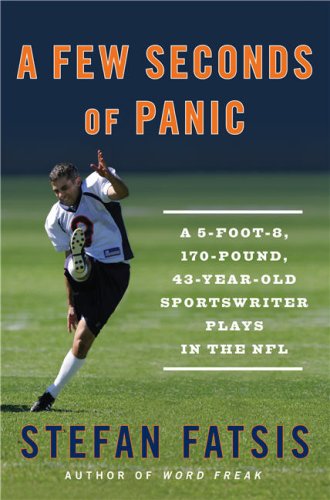
Review: A Few Seconds of Panic
Friend of the blog Paul recommended this book, and within a week of his doing so my on hold copy had arrived at the library. The last sports book I delved into was Satchel so I was leery of taking on another one. But, I'm certainly glad I did. You can find the review below the break.
Labels:
Football,
Nonfiction,
Review,
Sports,
Stefan Fatsis
30 November 2009
Review: V for Vendetta
V for Vendetta is the second Alan Moore book I've read, and further proof that I need to keep delving into the graphic novel/long-form comic genre. The first Moore I came across was the highly-recommendable Watchmen that I read earlier this year, and should probably write about at some point. But V for Vendetta was also pretty enjoyable. I'm glad I read it second, as I'm not sure it would have (by itself) convinced me the genre was worth the effort.
First, let me address the storytelling. Alan Moore is a superb writer, and his stories are compelling, well-paced, and enjoyable to read. V for Vendetta is set in a dystopian England of 1997-8. There has been some sort of calamity (probably nuclear) that has left much of the world destroyed. In this event's wake, a fascist regime has taken control of England, let by "The Leader" who has control of bureaus of intelligence and propaganda called "The Eyes" "The Nose" "The Ears" and "The Mouth." The regime has culled minorities from England, but those who are left lead fairly normal lives.
Yet there is one man who is willing to stand up to the tyranny of the government. He was the victim of hormonal testing in one of the concentration-style camps, and he is single-handedly attempting to bring about revolution. What's interesting about V (our main character), is that he doesn't hope to bring about Democracy, but rather Anarchy, which he sees as the ultimate path to freedom. By systematically killing the leaders of the fascist regime, V hopes to bring this about.
There's a lot to be said in this book about the debate of how best to achieve freedom. Is it, like V proposes, through total Anarchy that begins as chaos and eventually ends in self-policing? Or is it, more traditionally, through some sort of social contract? I truly don't think that V's anarchist ideals could ever work on a large scale, but perhaps in a case where the only sustainable government is a brutal one, there ought to be no government. The book also delves into what might become of the world if nuclear war were to occur? Sure, it's a cliched topic, but one that never ceases to interest me.
But I can't give this book the high praise that I will eventually laud on Watchmen. I think it's because of the artwork. David Lloyd's art here is at times stunningly beautiful, make no doubt about it. The idea to set the "Vicious Cabaret" scene tilted 90 degrees from normal and with music running throughout was brilliant (see the picture below for an example). My problem is that the characters aren't very distinguishable. In Watchmen, you could tell any character from any distance. In V for Vendetta, I was often trying to figure out who people were by their hairstyles. I appreciate the detail that allows me to see specific hairstyles, but I think that characters ought to be readily identifiable for ease of reading. If I want to go back and marvel at the detail around them, that's fine. But slowing every frame to figure just who is talking was tiring at times.
Overall though, I think this is a book I would recommend. Don't let it be your first graphic novel though. I thought Watchmen was a great choice as a first, but Kat at FoBoBlo (who knows way more about this stuff than I do) thinks otherwise. Looking through our GChats, I can't find what she recommended as a first instead (Kat, maybe you can comment and help?) but I know it definitely wasn't Watchmen. I pretty much ignored her on that one.
ANYWAYS. Go ahead, read something and get into graphic novels, and then pick up a copy of V for Vendetta. It's well worth it: great story, and despite my nitpicking, some really fantastic artwork at times.
First, let me address the storytelling. Alan Moore is a superb writer, and his stories are compelling, well-paced, and enjoyable to read. V for Vendetta is set in a dystopian England of 1997-8. There has been some sort of calamity (probably nuclear) that has left much of the world destroyed. In this event's wake, a fascist regime has taken control of England, let by "The Leader" who has control of bureaus of intelligence and propaganda called "The Eyes" "The Nose" "The Ears" and "The Mouth." The regime has culled minorities from England, but those who are left lead fairly normal lives.
Yet there is one man who is willing to stand up to the tyranny of the government. He was the victim of hormonal testing in one of the concentration-style camps, and he is single-handedly attempting to bring about revolution. What's interesting about V (our main character), is that he doesn't hope to bring about Democracy, but rather Anarchy, which he sees as the ultimate path to freedom. By systematically killing the leaders of the fascist regime, V hopes to bring this about.
There's a lot to be said in this book about the debate of how best to achieve freedom. Is it, like V proposes, through total Anarchy that begins as chaos and eventually ends in self-policing? Or is it, more traditionally, through some sort of social contract? I truly don't think that V's anarchist ideals could ever work on a large scale, but perhaps in a case where the only sustainable government is a brutal one, there ought to be no government. The book also delves into what might become of the world if nuclear war were to occur? Sure, it's a cliched topic, but one that never ceases to interest me.
But I can't give this book the high praise that I will eventually laud on Watchmen. I think it's because of the artwork. David Lloyd's art here is at times stunningly beautiful, make no doubt about it. The idea to set the "Vicious Cabaret" scene tilted 90 degrees from normal and with music running throughout was brilliant (see the picture below for an example). My problem is that the characters aren't very distinguishable. In Watchmen, you could tell any character from any distance. In V for Vendetta, I was often trying to figure out who people were by their hairstyles. I appreciate the detail that allows me to see specific hairstyles, but I think that characters ought to be readily identifiable for ease of reading. If I want to go back and marvel at the detail around them, that's fine. But slowing every frame to figure just who is talking was tiring at times.
Overall though, I think this is a book I would recommend. Don't let it be your first graphic novel though. I thought Watchmen was a great choice as a first, but Kat at FoBoBlo (who knows way more about this stuff than I do) thinks otherwise. Looking through our GChats, I can't find what she recommended as a first instead (Kat, maybe you can comment and help?) but I know it definitely wasn't Watchmen. I pretty much ignored her on that one.
ANYWAYS. Go ahead, read something and get into graphic novels, and then pick up a copy of V for Vendetta. It's well worth it: great story, and despite my nitpicking, some really fantastic artwork at times.
Labels:
Alan Moore,
David Lloyd,
Fiction,
Graphic Novel,
Review
Subscribe to:
Posts (Atom)