Showing posts with label Nonfiction. Show all posts

11 May 2010

Review: Are We Winning?

Anyone who has read what I write here knows that I love baseball. It is, without question, the greatest sport ever put on this planet, and one of my absolute favorite ways to spend a few hours. So despite the fact that I was not smitten with his last work (God Save The Fan, essentially a collection of long-winded Deadspin essays), I couldn't wait to get my hands on Will Leitch's new book, Are We Winning? Fathers and Sons in the New Golden Age of Baseball.


Leitch is at his best when he writes about baseball. He's got a way with words that incorporates the modern view of the game with the romanticized purple prose of bygone years. It's easy to understand why: he grew up idolizing newspaper legends and went to the University of Illinois with the explicit purpose of becoming one of them. His two passions have been movies and sports, and it is in the field of sports that he truly shines.

Leitch grew up as a Cardinals fan, and he's been able to avoid any wavering from that, thanks in large part to his father. The elder Leitch gave his son sage advice when he left for college: "There's going to be a lot of Chicago people up there, and a lot of Cubs fans. You can fool around with a Cubs fan if you want, but don't you dare bring one home." Are We Winning? is primarily a book about the relationship of Will and Bryan Leitch, and how that has been built around baseball. Bryan Leitch seems like an amazing guy, but he also seems like the stock character father from the Midwest: stoic, hard-working, hard-drinking, and with charisma that bubbles over, allowing him to make friends with anyone anywhere (as with a man at Wrigley wearing a Cubs shirt and a Cardinals hat [makes me sick to my stomach to hear about that]).

The best parts of the book are unquestionably those that deal with the father-son dynamic. Leitch manages to make his stock-character father seem like something more than that. He could have easily left his father with the stereotypical traits and had a fine story, but instead he delves even further and allows the reader to see past the clip-art version of a Midwesterner.

Other parts of the book seem to lag just a little, but probably only because of their juxtaposition with the father-son bits. Are We Winning? is organized into the half-innings of a game that Leitch and his dad attended at Wrigley in 2008. The two die-hard Cardinals fans unwittingly ended up at the game where the Cubs are given the chance to clinch the NL Central against the Cardinals, while Tony LaRussa's squad floundered just out of reach of playoff contention. In each half-inning Leitch weaves general baseball stories with play-by-play of the game and the bits of the father-son relationship.

The general thesis of the baseball stories seems to be, as implied in the subtitle, that baseball is better now than it has ever been. This flies in the face of many baseball old-timers, who see the sport as constantly leaving its better days behind. But Leitch is able to offer a convincing argument: more people watch baseball now than have ever done so before, they are able to access more and better information than before, and the players are better than they ever have been. He's right on all three counts. The athleticism of even the worst baseball players (read: Yuniesky Betancourt) is better today than ever before, and it's led to better baseball. And with MLB.tv and other advances from MLB Advanced Media as well as innumerable blogs and other websites dedicated to baseball, we're more able to access information about this better game. I'm able to follow the Seattle Mariners while living in Washington, DC, and I'm actually able to do so better than I did when I lived in Washington state 6 years ago. That is incredible.

But what happens in the book is that these baseball stories get overshadowed by how incredibly good Leitch's writing about his father is. I love reading random bits about baseball, especially when they're written by Will Leitch. But here, I wanted to read even more about his dad. Maybe this is just the desire for a deeper connection with a parent over baseball. My dad never cared about baseball too much (always supported my little league playing, and went to Mariners games with me, but hates them for being "crybaby millionaires"), and though my mom coached my little league team and always let me watch the Mariners, she hardly follows them any more (she told me the other day "I really only know two guys on this year's team: Griffey and Ichiro." She didn't know Felix Henandez, one of the top-3 pitchers in the American League. See what I mean?). I'd love to have a baseball connection with a parent like Leitch does, and I think that's what made his stories so compelling, and what made the purely baseball anecdotes so anticlimactic.

That said, I can't recommend this book enough. It has some flaws (Leitch periodically reintroduces anecdotes throughout the book that he has already used before several times, and always treats them as new. This really annoyed me for some reason.), but they don't end up doing any major damage to the book. It's a quick read, and one that I'll probably come back to at some point. Why? Because even with its problems, baseball is still the best thing around. Like Leitch says, "We expect baseball to be perfect, all the time. And it is perfect. But it is run by human beings, who are far from perfect, who are not even close." No matter what those human beings do, they can't change the fact that baseball is perfect. Thanks, Will, for reminding why I love this game so damn much.

02 May 2010

Sunday Book Banter: May 2, 2010

As promised here is the return of Sunday Book Banter. I swear I'm going to be a better blogger...


In today's Washington Post, we get a review of former MLB-er Doug Glanville's new baseball memoir, The Game From Where I Stand. Glanville never really made it onto my radar of players I cared about, but the new book sounds like it could be a fun (and probably quick) read. Dave Sheinin writes:

Glanville, who contributes a column to the New York Times, is a witty, insightful writer, and his detailed descriptions of the unseen banalities and secret vanities of the baseball life -- how players pass the time during rain delays, the proper way to pack an equipment bag after you've been cut, the admission that players practice signing their autograph -- are sometimes riveting and often amusing, even for those of us already intimately familiar with that life. 

Sheinin, I should note, wrote one of the better baseball stories I've read in a while for last Sunday's Post; a great write-up on Stephen Strasburg's first weeks in professional baseball.  If you haven't had the chance to read it, do so, it's got a certain poetry to it. (I kind of love the old-school Romanticism of baseball, and Sheinin does a great job of bringing that back).

Back to the book at hand, apparently it isn't too big on naming names or avoiding clichés (player superstitions!), but Glanville does provide a nuanced approach to the steroid controversy. As a player representative to the union, one expects Glanville to want a hush-hush over steroids, but he also claims to have never used them (and with anemic power throughout his career, I think we can trust him). So he has to be conflicted between his commitment to player privacy and his anger at those who tried to get ahead of him by using drugs. I'll certainly be looking for the book. Seems like it should be a quick read, and it will probably have the little day-to-day baseball stuff that I am always eager to read about (see this review).

28 April 2010

Review: The Guns of August

My Aunt May has been telling me to read Barbara Tuchman's The Guns of August for what seems to be ages. Boy was I stupid not to do so as soon as she recommended it. Tuchman's work recounts the first month of World War I: August, 1914. I have to admit to knowing very little about WWI, but this made for a great primer into the causes of the war as well as the reasons it got bogged down in the trenches.


A few things surprised me about the opening month of the war. The first was the transitional state that war was in. We tend to think of war as something that happened before mechanized weaponry or something that happened after. WWI shows that this was not the case. Weaponry used in battle of course included heavy artillery, rifles, airplanes, and machine guns. But it also included lances, bicycles, horses, and bayonets. Some of the massive casualties were undoubtedly caused by these discrepancies in firepower. I had the hardest time wrapping my mind around the idea of war that wasn't quite 19th Century but also wasn't firmly 20th Century either.

But the highlight of this book is Tuchman's writing. It took me a while to read, but a lot of that was owed to thesis writing. Tuchman's prose is absolutely gorgeous, and it draws you in. Throughout the book, I found myself angry and sympathizing with the Germans, British, French, Russians, and Belgians. She didn't allow retrospective history to get in the way of writing: the Germans aren't evil, and the British aren't demi-gods. All of the participants are instead just fallible human beings. Its devastating to realize how much human life was lost in the stupidity, and Tuchman really details the magnitude of tragedy involved, regardless of side.

While a lot of people who read the book focus on the (admittedly wonderful) first paragraph, I had a different favorite that really shows Tuchman's style. In Chapter 22, as she is setting up the Battle of the Marne that was to decide the fate of France, Tuchman writes this:

September 4 opened with a sense of climax felt in widely separated places; a kind of extra-sensory awareness that great events sometimes send ahead. In Paris, Gallieni felt this was the "decisive" day. In Berlin, Princess Blücher wrote in her diary, "Nothing is talked of but the expected entry into Paris." In Brussels the leaves had begun to fall, and a sudden wind blew them in gusts about the street. People felt the hidden chill of autumn in the air and wondered what would happen if the war were to last through the winter. At the American Legation Hugh Gibson noted a "growing nervousness" at German Headquarters where there had been no announcements of victories in four days. "I am sure there is something big in the air today."

What a beautiful way to set the stage for one of history's most important days.

If you haven't read The Guns of August and you have even a modicum of interest in history, pick up a copy. It is easily one of the best history books I've ever come across.

04 March 2010

"Last Train From Hiroshima" Withdrawn

I wrote about Charles Pellegrino's Last Train From Hiroshima a few weeks ago. Since then, the books publisher has been alerted to several glaring factual errors in the book. In a recent post, Jacket Copy does a great job of detailing what has happened. But it's your typical history book story of "My sources lied!" That seems fair enough, but as the publisher has dug more deeply into the book they've found more and more problems, including the inclusion of someone who doesn't exist (Pellegrino says it was a pseudonym).

An interesting question that Jacket Copy raises is: how much should publishers fact check? Obviously, they can't check everything. There are bound to be errors. But in a book that received so much press and attention, why did it take Henry Holt (the publisher) so long to check it out?

Needless to say, the book is no longer on my to-read shelf. And as far as Pellegrino? He appears to have taken his cue from Major Kong and ridden The Bomb to his own death.

02 March 2010

Review: Odd Man Out


Aside from music, one of my biggest passions in life is baseball. Since 1994 I've been a huge fan of the Seattle Mariners. I care far too much about baseball and spend far too much time reading about it online. But one thing I don't read enough of is baseball books. When I read The Boys of Summer by George Kahn, I loved it (or at least the first half of it). I've read some other baseball stuff that is just superb. But then you get the real clunkers. And when a baseball book stinks, it's just unbearable. I want them to be good so badly that it upsets me when they are not.

Well I was killing some time at the UMD bookstore the other day, and came across Odd Man Out: A Year on the Mound with a Minor League Misfit by Matt McCarthy. I'm not sure why it struck me, but I looked it up on my Kindle and downloaded it there. I've never been happier with a baseball book in my life. It doesn't have any of the sabermetric statistics that I'm learning to like, and it isn't really advanced technically. What it is is a superb recounting of McCarthy's year in the Anaheim Angel's farm system.

McCarthy was a left-handed pitcher for an abysmal Yale team. In 2002, after graduating from one of the top universities in the world, he was picked in the 21st round of the amateur draft by the Angels. 21st-round picks are usually people that will never make an impact on the big-league team. And the same is true of McCarthy. But his assignment to the Provo Angels, based in the geographic heart of the Mormon religion provides for some fantastic stories, and we're lucky they were experienced by someone who can write as well as McCarthy does.

He tells of extended spring training and his time in Provo, UT. But the best part of the book is the detailing of the players themselves. We get some big names (new Mariners 1B Casey Kotchman's dad is McCarthy's manager in Provo. White Sox closer Bobby Jenks makes a cameo as a drunk blowhard [which in turn makes me like Jenks even more now that I see his complete transformation], Joe Saunders is hated by his teammates, Ervin Sanatana puts no effort into his game, and Alberto Callaspo engages in hijinks galore), and we get some people that even the most avid baseball fan hasn't heard of.

These are the people that make the story special. Two players come immediately to mind, and both were (at one point) McCarthy's roommates. The first roommate, always referred to as Sunshine, was a bit of an eccentric player, who most of the team thought was only there as a favor. He served the season as the bullpen catcher, one of the least glorious jobs in all of baseball. After initially disliking him, McCarthy seems to end up with a great fondness for the crazy Californian.

The other is Randy Burden, a devout Christian who tried to push the Bible onto McCarthy while also trying to be supportive in a non-imposing way. McCarthy details the brusque manner in which he treated Burden, and then reveals that Burden died after the 2002 season. You can sense a profound regret in McCarthy's writing both that he wasn't there for his teammate in life, and afterwards. These segments must have been very difficult for McCarthy to write, as he lays himself out as kind of an ass.

The other truly inspiring character is Tom Kotchman, the Provo Angel's manager. The way he is described, he is truly a "player's manager."If his team plays baseball the "way it was meant to be played" he'll do anything for them. At one point, Kotchman offers any money that his players need with no strings attached. For some, this was they only way they could eat on the meager rookie-ball salary they received. As clichéd as it sounds, I absolutely loved this bit from Kotchman:
If you play hard for me, I will do anything for you. Anything! And to see some of you just going through the motions... it kills me. You're disrespecting the game!
These kids were given the chance to live the dream of thousands of people. To play professional baseball. And while you can't blame them for taking it for granted (most people who routinely do amazing things take them for granted), you have to appreciate what Kotchman is trying to instill in his players.

The author is very straightforward about the fact that he wasn't a very good pitcher. Without fear of spoiling anything (it pretty much gives the ending on the back cover), I note that even though McCarthy got cut in Spring Training of 2003, he's not doing too shabbily for himself: having attended Harvard Medical School.

If you're looking for a good baseball book, but this one now. The pace was fast and the story telling was phenomenal. I can't recommend it enough.

18 January 2010

Review: Battle for America 2008

I've been looking for a good inside-story sort of book about the 2008 presidential election for a while now. When the Washington Post reviewed The Battle for America: The Story of an Extraordinary Election, I was intrigued enough to place a copy on hold at the library. The book wasn't exactly what I was looking for, but it wasn't bad either.


I was hoping that this book would provide a ton of insider information that you couldn't get elsewhere. And in a way, it did. There are interviews with countless staff members on each of the major campaigns all the way up to the candidates themselves. But interviews alone don't cut it. The book is a phenomenal overview of the election for someone who wasn't there. Balz and Johnson have a knack for strong narrative, and the broad strokes that the book sometimes takes are great for what they are.

But I feel like what they are isn't enough. After an in-depth look at Iowa and New Hampshire for the Democratic primaries, Super Tuesday is wrapped up in just a few pages. From what I remember, that was the tensest time of the entire campaign. Hillary and Obama had split the four early states, so it was do-or-die in Super Tuesday. I'd love to have read more about the operations of both campaigns as they scrambled to get the necessary delegates.

And the other part of the campaign that lacks depth is the coverage of the Republican side of things. I closely followed the Democratic primaries, probably to the detriment of my knowledge in the Republican world. But I feel like a vast majority of people reading this book (if you're a Republican, why would you want to rehash a staggering loss?) are in the same boat. Sure, McCain had things wrapped up pretty quickly, but does that mean that the Democratic primaries should get literally three times more space in the book than the Republican counterparts?

Balz and Johnson also had the annoying habit of assuming a bit too much knowledge. In the final chapter, they wrote this:

The S&P index of the leading five hundred stocks had fallen more than at any time since 1937, with every sector taking double-digit hits...

What in the world does "double-digit hits" mean? Are we talking in terms of percentages (and percentage of what?)? Is it in terms of dollars (a $75 hit doesn't sound too bad to me)? Is it in terms of public opinion? The metric of the S&P 500 itself? I can't tell, and too often Balz and Johnson leave loose ends like this.

That said, the book is a superb broad narrative of the election. A great reminder of how things played out in the larger sense. Maybe I just need to pick up a copy of A Long Time Coming by the staff at Newsweek. Every election cycle they send reporters with the campaigns under the promise that whatever they collect will not be written until after the election. Maybe in that book I can find more of the nitty-gritty for which I was looking.

05 December 2009

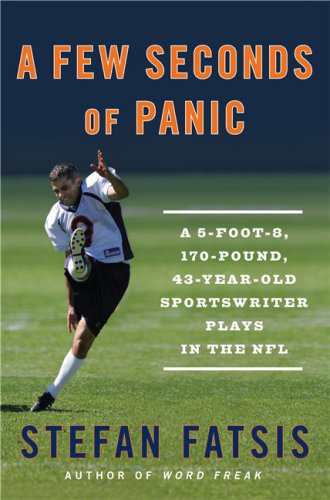
Review: A Few Seconds of Panic

Friend of the blog Paul recommended this book, and within a week of his doing so my on hold copy had arrived at the library. The last sports book I delved into was Satchel so I was leery of taking on another one. But, I'm certainly glad I did. You can find the review below the break.


21 November 2009

Review: Classic Feynman

I have a fried who is always telling me what great reading the books of physicist Richard Feynman are. I finally got one from the library the other day, Classic Feynman: All the Adventures of a Curious Character. It's a collection of two books of his, Surely You're Joking, Mr. Feynman! and What do You Care What Other People Think? that has been compiled by Feynman's friend Ralph Leighton.


A bit of biography before I get into the review. Feynman was born in 1918 and went to school at MIT and Princeton for physics. While at Princeton, he was recruited to work on the Manhattan Project. After the war he taught at Cornell and the finally Caltech, where he achieved his greatest fame. In 1961 Caltech was worried that it's entry level physics course was not modern enough, so they asked Professor Feynman, one of the leading quantum physicists in the world, if he would teach the course. Much to everyone's surprise, he agreed, though he had one condition: he would only teach the course once. Caltech wisely recorded all of the lectures (later released in this set) and took pictures of every blackboard diagram he made.

In 1965, Feynman won the Nobel Prize in Physics for his work in quantum electrodynamic (no, I'm not quite sure what that is either). He was also a member of the presidential commission to investigate the causes of the 1986 Challenger explosion. In 1988 he died of a rare form of cancer.

Now that I have that out of the way, the book itself. It's a must read for anyone even vaguely interested in Feynman the person. Most of the stuff here isn't hard physics, and could certainly be understood by all (the difficult math and science that does pop up is not necessary for understanding the stories themselves). What you get are anecdotes from a fantastic story teller. How about cracking into the safes at the Manhattan Project? Or carousing with women in Brazil? The book is arranged in roughly chronological order so you work your way through Feynman's life without the structure of a biography.

But as good as the stories are, they can drag after a bit. Though they are all excellently told and read quickly, it seems like you're hearing mere variations on a theme. I was ready to give this book an interested-but-not-for-this-long "meh" until I reached the section about the Challenger crash investigation. The Challenger was the space shuttle that exploded 73 seconds after liftoff in January of 1986. Feynman's telling of the investigation and bureaucratic nightmares he faced in at once fascinating, gripping, and infuriating. Why would he be stopped from investigating when no one else wanted to? Why should he not put his nose in NASA's business? It was his mandate! This section completely saved the book for me.

And lest you should end on a bit of a sour note, there are a couple pieces at the end that wrap things up nicely. One is a commencement address Feynman gave to the 1974 Caltech class that encourages the students to make sure they research with integrity, not try merely to get funding. The other is Alan Alda's (yes, the actor) 2002 commencement address to the same school in which he makes an interesting proposal to the students:
What if each of you decided to take just one thing you love about science and, no matter how complicated it is, figure out a how to make it understood by a million people? There are about 500 of you taking part in this ceremony today. If just a few of you were successful, that would make several million people a lot smarter. 
What a brilliant idea. In the end, that's what I'm going to take from this book. Feynman doesn't try to impress with big words or lofty ideas; he lets the science amaze you itself. And he tries to make it understandable for anyone, so we can all get a glimpse at how incredibly amazing our universe is.

28 July 2009

The Trouble with Biographies

I went to the library a couple weeks ago and saw a copy of Larry Tye's new biography Satchel sitting on the new book shelves. It being the middle of summer and the Mariners having not played themselves out of contention yet (those were the days), I decided a baseball book would be perfect. Now, I knew almost nothing about Satchel Paige coming into the book aside from the fact that he was an exceptionally good pitcher.

Now, 123 pages into the book, I'm wondering why I got it in the first place. I mean, it's certainly not a bad book, I just can't bring myself to be that invested in it. Tye does a fine job depicting the life of Paige (though there is some chronological jumping that infuriates me, more on that when I review the book), but it just isn't amazing. And it's made me remember that in general, I don't really like biographies. (That's a little bit weird for a music historian, right?)

Why not? They can have amazing subjects (who doesn't want to know more about Einstein? FDR? Frida Kahlo?) and can be written by fantastic authors. But even the most amazing lives often lack the narrative drive that makes great works of literature so amazing. We're all used to digesting the life of George Washington as a series of bullet-point facts. Unless a biography really elaborates on that, you might as well read the wiki article.

This shouldn't be construed as me saying "There are no good biographies!" Because there are, they're just very rare. I loved the David McCullough biography of John Adams because it showed the founding father in an intensely personal life. The use of his letters with Abigail made for some heart-rending moments, some truly literary moments.

And that's what I think it boils down to, biography lacks the emotional and narrative drive of great literature. Learning facts for bar trivia is great (in 1935 Satchel Paige went 29-2 with 321 strikeouts to only 16 walks... mind blowing), it doesn't make for the most compelling reading. How often do you sit down with your college text books for a nice afternoon? I guess I just have to remember this the next time a glossy cover of a biography yells at me from the shelves in the library.